Computer Repair · October 25, 2026 · ComputerKing Team
RAID Recovery: Read the Quote First — 10 Questions on Diagnosis, Disk Order, Imaging, Rebuild Risk and Delivery
After a RAID array fails, the most expensive mistake is not always losing the data — it can be signing a recovery quote you have not understood. Read the quote in four parts, and compare like with like before you decide.
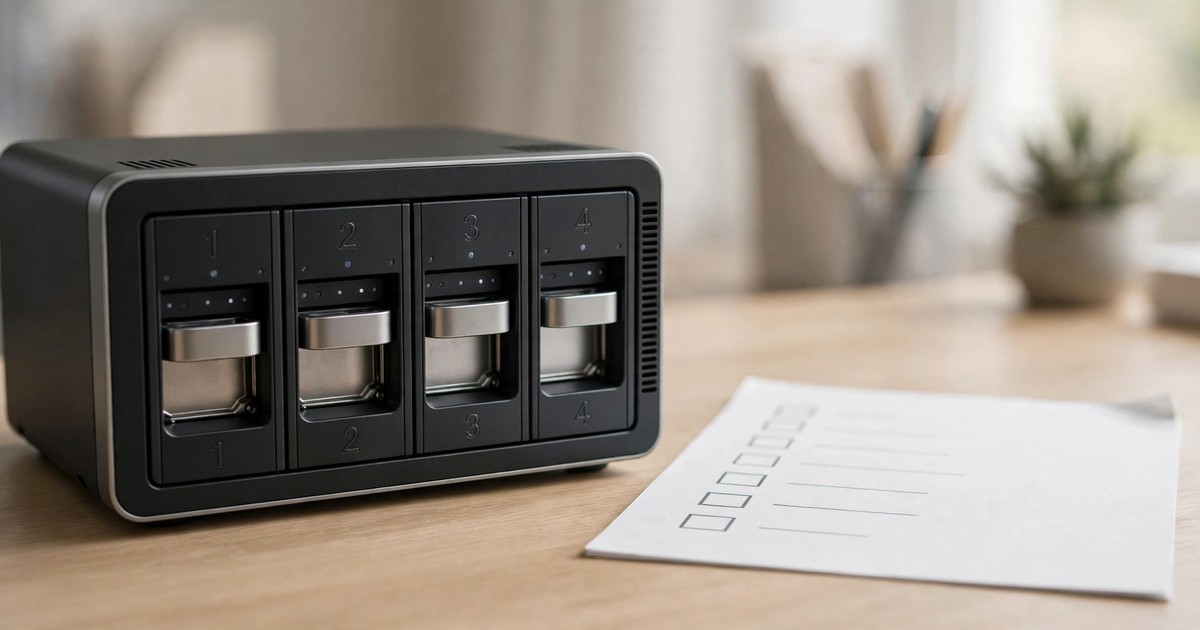
Key Summary: After a RAID array fails, the most expensive mistake is not always losing the data — it can be signing a recovery quote you have not understood. Read the quote in four parts, get the diagnosis fee, handling method, data handling and delivery in writing, and compare like with like before you decide.
Introduction
A company NAS reports a degraded array, the accounting system and shared folders stop opening, and the first reaction is often to get someone to fix it as fast as possible. That urgency is understandable, but RAID is not a single hard drive: several drives form one array, and every decision affects all of them at once. A quote that leaves out one item can lead to extra charges later, an unclear fate for the original drives, or data-handling arrangements that were never agreed.
This article does not teach you how to rebuild RAID yourself. That is covered in another article in this series, on RAID recovery for Hong Kong SMEs, which explains RAID levels, what not to do before a rebuild, and when to stop. This article covers only the next step after a failure: how to read a quote, what to ask, and how to compare two quotes. The two articles have clearly separate jobs, and this one does not repeat the technical steps of the other.
1. Why a quote cannot be judged by its total alone
Behind the total of a RAID recovery quote there are at least four things, and if any one of them is vague, a dispute can follow.
The first is the diagnosis fee. Checking a RAID array means examining each drive, checking the array configuration, and judging which drives can still be read, and that work itself has a cost. A quote should state the diagnosis fee, whether you pay it if you decide not to proceed after inspection, and whether it is deducted from the recovery fee later.
The second is the handling method. A quote should state whether the first step is a read-only image — copying each drive's contents unchanged somewhere else, then working on the copy. If a quote says nothing about the handling method, you have no way to judge whether the original drives will be worked on directly.
The third is data handling. During recovery, technicians unavoidably come into contact with company data, so a quote should state how data is stored, who may view it, and how working copies are deleted afterwards. Company data is not an ordinary file, and this part must not be left unwritten.
The fourth is delivery time and price changes. RAID recovery is not always finished the same day: more drives, larger capacity and more complex faults all take longer. A quote should state the expected delivery time, whether that time may change after inspection, and whether you will be asked first before any price change.
Table 1: The four parts of a quote
| Quote part | What must be written down | What goes wrong if it is vague |
|---|---|---|
| Diagnosis fee | Fee amount, whether it applies if you decline, whether it is deducted later | You learn about the fee only after the work, or it is counted twice |
| Handling method | Whether a read-only image is made first, and where the work happens | Direct work on the originals, with write risk nobody owns |
| Data handling | Storage method, who may view data, how copies are deleted | Company data goes somewhere unknown, and cannot be traced later |
| Delivery and price changes | Expected delivery time, whether you are asked before a price change | Urgent work with no date, or a price rise notified only afterwards |
2. Ten questions to ask before sending an array in
These ten questions are not meant to trap a repairer. They exist so you can tell which quote deserves trust. Write down each answer, and two quotes placed side by side become easy to compare.
Question 1: How is the diagnosis fee charged? If you decline after inspection, do you still pay the full diagnosis fee? Is the diagnosis fee deducted from the recovery fee?
Question 2: Will inspection change the original drives? Is the first step a read-only image of each drive, with analysis done on the copy afterwards? If a repairer says they will run repair tools directly on the original array, it is worth asking why imaging is not done first.
Question 3: How is disk order recorded? The physical order of drives in a RAID array matters a great deal, so does the quote include labelling and recording in the original order? Have you photographed the drive bays and cables yourself before sending the array in? The technical reasons are explained in the companion article in this series; this article only reminds you that the quote should include this step.
Question 4: How is the array configuration confirmed? How will the repairer confirm the original configuration, such as which level it is and which drive failed first? If the configuration is confirmed wrongly, the whole direction of the work can be wrong.
Question 5: What counts as recovered, and what may be unrecoverable? Does the quote define "recovered" as files that actually open, or merely as file names that are visible? That definition changes what the fee result means.
Question 6: What happens if inspection finds more than one faulty drive? The most common variable in RAID work is discovering a second faulty drive during inspection, so does the quote say how that is charged, and whether work stops for your decision first?
Question 7: How is recovered data delivered? What medium is used to hand the data back? Is the medium included in the price? Will the original drives be returned? Original drives may hold other data, so their fate must be written down.
Question 8: How are data confidentiality arrangements handled? Who may view your data? When and how are working copies deleted after the work? If your company has internal rules, this question is essential.
Question 9: How long will delivery take? What is the expected number of days? Is the date only an estimate, or a commitment? If your company urgently needs one folder, is there a staged delivery arrangement, with the most urgent part first?
Question 10: What happens if nothing can be recovered? If the result is nothing, or only part of the data, how is the fee charged? How is "nothing recovered" defined? This must be written down before signing, not argued after the work.
Table 2: The 10-question checklist
| Question | What it establishes | An answer worth worrying about |
|---|---|---|
| 1. How is the diagnosis fee charged? | Separates diagnosis from recovery fees | A vague fee, explained only after the work |
| 2. Is a read-only image made first? | Protects the originals from writes | Direct work on the originals, unexplained |
| 3. How is disk order recorded? | Array order must not be lost | "Order does not matter" |
| 4. How is the array configuration confirmed? | Whether the direction is right | A guaranteed result before inspection |
| 5. What counts as recovered? | Files that open, not just names | File names visible counted as recovered |
| 6. What if more drives are faulty? | Room for variables, no mid-work surprises | "The price will never change", unwritten |
| 7. How is data delivered? | Medium and original drives' fate | Original drives' fate not mentioned |
| 8. How is confidentiality handled? | Company data protection | No mention of data handling at all |
| 9. How long is delivery? | Planning company operations | A same-day promise, unconditional |
| 10. What if nothing is recovered? | Agreed in advance, not argued later | Full fee even when nothing is recovered, unstated |
3. How to judge the handling method written in a quote
Handling methods in a quote usually fall into three kinds. You do not need to know every technical detail, only which kind is more careful.
The first kind is making a read-only image first, then analysing and rebuilding on the copy. This is the most protective for the originals, because the original contents are not changed during analysis. A quote that states this step deserves credit.
The second kind is replacing a drive and rebuilding following the manufacturer's official process. This applies only in a narrow set of cases, as explained in the companion article: a single drive problem, an array that still opens, and a backup already in place. A quote that presents this as suitable for every case should be treated with care.
The third kind is running repair, initialisation or formatting tools directly on the original array. This carries the highest risk, because any write can overwrite parts that might still have been recoverable. A quote that states this kind of work without explaining why should be questioned, and a second quote is worth getting for comparison.
Table 3: Handling methods compared
| Handling method | Effect on the originals | How the quote should state it |
|---|---|---|
| Read-only image first, work on the copy | Originals unchanged, most protective | State the imaging step and working-copy arrangements |
| Rebuild following the official process | Only suitable in narrow cases | State the conditions, not as a universal fix |
| Repair, initialise or format the original array directly | Writes may overwrite recoverable parts | Must explain why, otherwise question it |
4. Red flags: stop and ask more questions first
The following statements do not prove a repairer is at fault, but they mean you should pause and ask more before signing.
First, a firm figure quoted before inspection, with a claim that it will definitely not change. Before a RAID array is inspected, the extent of damage cannot be seen, so a firm figure is very likely only an estimate.
Second, a claim that recovery is "guaranteed". RAID damage varies too much for a result to be guaranteed in advance. A credible explanation states the method, the risks, and what may be unrecoverable.
Third, a quote that says nothing about data handling. Company data is not an ordinary file, and a quote with no storage, viewing-rights or deletion arrangements has not treated that part as part of the quote at all.
Fourth, being told to format or run repair tools yourself before sending the array in. Those operations rewrite the array and file system, and should stop before sending, leaving judgement to the inspection stage.
Fifth, no mention of what happens to the original drives. Original drives may hold other data, or you may want to keep them for reference, and an unwritten fate becomes hard to trace later.
Table 4: Red flags
| Red-flag statement | Why to be careful | What to do |
|---|---|---|
| A firm figure before inspection, said never to change | Damage extent unseen, the figure may be only an estimate | Ask whether it is an estimate or a fixed price |
| "Guaranteed recovery" | Damage varies, a guaranteed result is not credible | Ask for method and risks |
| No mention of data handling | Company data protection has no arrangement | Ask about storage and deletion |
| "Format it first, then send it in" | Formatting rewrites the array and file system | Stop, leave it to inspection |
| Original drives' fate not mentioned | Originals may hold other data | Ask before sending whether they are returned |
5. How to compare two quotes fairly
With two quotes in hand, do not compare totals directly, because what each total includes may be completely different. Compare them item by item using the same table.
First compare diagnosis fees: how is each quote's diagnosis fee charged? Do you pay if you decline? Is it deducted later?
Then compare handling methods: does each quote state that a read-only image is made first? If one states it and the other does not, the unstated one is not cheaper, only less clearly explained.
Then compare data handling and delivery: is the delivery medium included? Are the original drives returned? How are working copies deleted? If any of these differ, the totals cannot be compared directly.
Finally compare delivery time and price-change arrangements: what is each expected delivery time? If a new problem is found mid-work, which quote states that you are asked first? Which quote defines "nothing recovered"?
Table 5: Comparing two quotes
| Comparison item | Quote A | Quote B | Which is clearer |
|---|---|---|---|
| Diagnosis fee | Fill in the answer | Fill in the answer | The one stated in advance |
| Read-only image first | Yes / No | Yes / No | The one that states it |
| Data handling | Yes / No | Yes / No | The one that states it |
| Medium and original drives | Included / Not included | Included / Not included | The one that states it |
| Delivery and price changes | Stated / Not stated | Stated / Not stated | The one that states it |
After this comparison, you may find that the cheaper quote is simply missing items, and the more expensive one includes everything. The decision should not rest on the total alone, but on which quote leaves you clearest about what you are buying.
6. A five-minute checklist before sending an array in
Before signing a quote, spend five minutes on the following, and the whole process will run more smoothly.
First, note the array's basic facts: how many drives, which level, which drive failed first, and whether the unit still opens. Inspection will certainly ask these, and noting them in advance means you do not have to guess.
Second, photograph the drive bays and cables. Physical drive order matters, and a photograph is the simplest record, to be handed over with the unit.
Third, stop using the failed array. Continuing to use a degraded array is itself an extra risk, and writing new data to it while rushing work is not worth it.
Fourth, do not initialise or format it yourself. If the system says formatting is needed before use, do not press it, because that operation rewrites the array configuration.
Fifth, ask the ten questions in this article, write down the answers, and compare two quotes with the same table. Five minutes before signing can save days of argument afterwards.
Frequently Asked Questions
Q1: A repairer quoted a firm figure for my RAID array before inspection. Should I trust it?
Do not treat it directly as a fixed price. Before a RAID array is inspected, the extent of damage cannot be seen, so a firm figure is very likely only an estimate. Ask whether it is an estimate or a fixed price, whether the price will change after inspection, and whether you will be asked first before any change — then decide.
Q2: Must I always pay a diagnosis fee? Do I pay even if I decline recovery after inspection?
It depends on the repairer's arrangements. Some inspections require testing each drive, which itself has a cost. Some inspections are included in the recovery fee, charged only if you proceed. The point is not the fee itself, but whether it was stated in advance. The first question when asking for a quote should be how the diagnosis fee is charged.
Q3: Why does it matter whether the first step is a read-only image?
Because working directly on the original drives or array is itself a write risk. Imaging first, then working on the copy, gives the original data an extra layer of protection. If a repairer says they will run repair tools directly on the original array, it is worth asking why imaging is not done first.
Q4: What happens if disk order is mixed up?
Physical disk order is one of the key facts for rebuilding an array, and wrong order can send the analysis in entirely the wrong direction. Photograph the drive bays and cables before sending the array in, and make sure the quote includes recording drives in order, rather than assuming it will happen automatically.
Q5: A repairer says recovery is "guaranteed". Can I believe it?
Do not decide on that claim alone. RAID damage varies too much for a result to be guaranteed in advance. A credible explanation states the method, the risks, and what may be unrecoverable.
Q6: If nothing is recovered, have I wasted the diagnosis fee?
Not necessarily — it depends on the quote's arrangement. Some arrangements charge only the diagnosis fee when nothing is recovered; some charge by procedure. What matters is that the definition of "nothing recovered" and the charging arrangement are written down in advance.
Q7: Will my company data be seen by others during recovery?
During recovery, technicians unavoidably come into contact with data, so ask in advance how data is stored, who may view it, and how working copies are deleted afterwards. If the quote does not mention data handling, ask directly.
Q8: How are the original drives and the delivery medium arranged?
Ask before sending the array in. The original drives may hold other data, or you may want to keep them for reference. Whether the delivery medium is included in the price, and whether the original drives are returned, should both be stated on the quote.
Conclusion
When RAID fails, do not judge a quote by its total alone. Remember three things: first, read a quote in four parts — diagnosis fee, handling method, data handling, and delivery and price changes — and question anything left vague. Second, ask all ten questions before signing, especially how the diagnosis fee is charged, whether a read-only image is made first, how data is handled, and how a failed recovery is charged. Third, compare two quotes item by item with the same table, never by total alone. Finish the five-minute checklist before sending the array in, and the process afterwards will run more smoothly. For RAID levels and what not to do before a rebuild, see the companion article in this series; this article's job is to leave you clear-headed at the moment you sign a quote.
Sources
- Synology official support documentation (synology.com): general guidance on NAS array management and official rebuild processes; this article states only general practice, and specific steps should follow the manufacturer's current documentation.
- QNAP official support documentation (qnap.com): general guidance on NAS array management and official rebuild processes; this article states only general practice, and specific steps should follow the manufacturer's current documentation.
- Related article on this site, RAID recovery for Hong Kong SMEs (raid-recovery-sme-guide): detailed explanation of RAID levels, what not to do before a rebuild, and when to stop; this article links to it and does not repeat its technical steps.
Related Articles
- RAID recovery for Hong Kong SMEs (raid-recovery-sme-guide)
- NAS failure: a Hong Kong user's data recovery guide (nas-data-recovery-guide-hong-kong)
Frequently Asked Questions
A repairer quoted a firm figure for my RAID array before inspection. Should I trust it?
Do not treat it directly as a fixed price. Before a RAID array is inspected, the extent of damage cannot be seen, so a firm figure is very likely only an estimate. Ask whether it is an estimate or a fixed price, whether the price will change after inspection, and whether you will be asked first before any change — then decide.
Must I always pay a diagnosis fee? Do I pay even if I decline recovery after inspection?
It depends on the repairer's arrangements. Some inspections require testing each drive, which itself has a cost. Some inspections are included in the recovery fee, charged only if you proceed. The point is not the fee itself, but whether it was stated in advance. The first question when asking for a quote should be how the diagnosis fee is charged.
Why does it matter whether the first step is a read-only image?
Because working directly on the original drives or array is itself a write risk. Imaging first, then working on the copy, gives the original data an extra layer of protection. If a repairer says they will run repair tools directly on the original array, it is worth asking why imaging is not done first.
What happens if disk order is mixed up?
Physical disk order is one of the key facts for rebuilding an array, and wrong order can send the analysis in entirely the wrong direction. Photograph the drive bays and cables before sending the array in, and make sure the quote includes recording drives in order, rather than assuming it will happen automatically.
A repairer says recovery is "guaranteed". Can I believe it?
Do not decide on that claim alone. RAID damage varies too much for a result to be guaranteed in advance. A credible explanation states the method, the risks, and what may be unrecoverable.
If nothing is recovered, have I wasted the diagnosis fee?
Not necessarily — it depends on the quote's arrangement. Some arrangements charge only the diagnosis fee when nothing is recovered; some charge by procedure. What matters is that the definition of "nothing recovered" and the charging arrangement are written down in advance.
Will my company data be seen by others during recovery?
During recovery, technicians unavoidably come into contact with data, so ask in advance how data is stored, who may view it, and how working copies are deleted afterwards. If the quote does not mention data handling, ask directly.
How are the original drives and the delivery medium arranged?
Ask before sending the array in. The original drives may hold other data, or you may want to keep them for reference. Whether the delivery medium is included in the price, and whether the original drives are returned, should both be stated on the quote.